Long Division Calculator — Steps & Fractions
If 487 ÷ 32 has you stuck halfway through a subtraction, the long division calculator writes the whole thing out the way it is done on paper — 15 R 7, or 15.21875 — one step at a time.
- Type the number to divide and the number you divide by
- Press Calculate
- Step through the work
Enter a dividend and a divisor to see the long division written out step by step.
Check
Division theorem form
Step-by-step explanation
Next: press Next step to replay the work, or open “Make a practice sheet” below to try a few on paper.
Calculation history (0)
No calculations yet. Your last 10 divisions are kept in this browser only.
Make a practice sheet
Answer key
How do you do long division step by step?
Long division is one loop of four moves: divide, multiply, subtract, bring down (“Dad, Mom, Sister, Brother”). You go from the highest place value to the lowest, each round asking how many times the divisor fits into the partial dividend. Here is 487 ÷ 32, which stalls many fourth graders — and parents who last drew a division bracket years ago:
- Divide. 32 does not fit into 4, so take 48. It fits once: write 1 above the 8, not above the 4.
- Multiply and subtract. 1 × 32 = 32; 48 − 32 = 16, which is smaller than 32, so the 1 was right.
- Bring down the 7: the new partial dividend is 167.
- Divide again. 5 × 32 = 160 fits; 6 × 32 = 192 is too much. Write 5 above the 7.
- Subtract: 167 − 160 = 7. No digits are left, so the answer is 15 R 7.
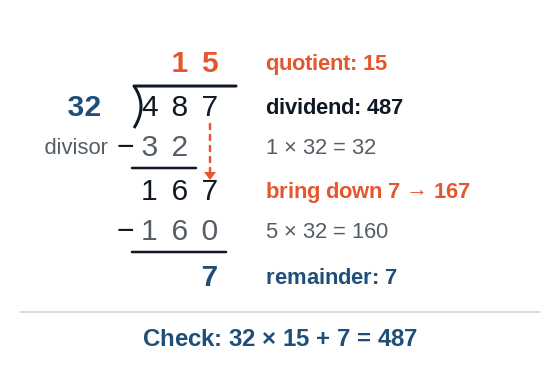
The long division calculator above starts with this problem in Dividend and Divisor. Press Calculate (or Enter) and the work appears on graph paper for your own numbers. Next step and Previous step move one row at a time with the current digit marked in orange; Play runs it, Show all fills in the rest, and the Step-by-step explanation says each move in a sentence — what “show and explain your work” asks for. A phone gives 15.21875 and nothing to compare with paper; when I help a child, I cover the next row and ask for the digit first.
Remainder, decimal or fraction — which answer does your homework want?
Grade 3–5 worksheets want the remainder (100 ÷ 7 = 14 R 2), measurements want a decimal, algebra wants a fraction. The calculator shows all of them, each with Copy, plus Copy all and a Check line.
| Division | Quotient and remainder | Decimal | Fraction | Mixed number | Percent |
|---|---|---|---|---|---|
| 487 ÷ 32 | 15 R 7 | 15.21875 | 487/32 | 15 7/32 | 1,521.875% |
| 100 ÷ 8 | 12 R 4 | 12.5 | 25/2 | 12 1/2 | 1,250% |
| 100 ÷ 7 | 14 R 2 | 14.(285714) | 100/7 | 14 2/7 | 1,428.(571428)% |
To turn a remainder into a fraction, put it over the divisor, then simplify with the greatest common divisor: 100 ÷ 8 = 12 R 4 = 12 4/8 = 12 1/2. The Fraction and Mixed number cards are always simplified.
15 R 7 is not 15.7. The 7 means 7/32 = 0.21875, so the decimal is 15.21875. This is the mix-up I see most on otherwise correct homework.
Why do some answers never end? Repeating decimals
For a decimal, put a point after the whole part and keep bringing down zeros. Every remainder is smaller than the divisor, so sooner or later one comes back — and from then on the digits repeat. In 1 ÷ 7 the remainders run 1, 3, 2, 6, 4, 5, then 1 again: 1 ÷ 7 = 0.(142857), a bar over the period. 22 ÷ 7 = 3.(142857) — close to π, not equal. In 1 ÷ 12 = 0.08(3) only the 3 repeats. The rule: reduce the fraction; if the denominator has no prime factors except 2 and 5, the decimal ends (487/32, since 32 = 2⁵ — five 2s), otherwise it repeats.
| n | 1 ÷ n | Ends or period |
|---|---|---|
| 2 | 0.5 | ends |
| 3 | 0.(3) | period 1 |
| 4 | 0.25 | ends |
| 5 | 0.2 | ends |
| 6 | 0.1(6) | period 1 |
| 7 | 0.(142857) | period 6 |
| 8 | 0.125 | ends |
| 9 | 0.(1) | period 1 |
| 10 | 0.1 | ends |
| 11 | 0.(09) | period 2 |
| 12 | 0.08(3) | period 1 |
| 13 | 0.(076923) | period 6 |
With Answer as set to Decimal and Decimal places on Exact (repeat bar), the calculator divides until a remainder returns, highlights it twice and draws the bar: “The remainder 1 came back, so the digits 142857 repeat forever (period 6)”. For long periods (355 ÷ 113 repeats after 112 digits) it shows 100 digits and the period length. For “4 decimal places” pick 4: the answer is rounded half up and labelled, so 2 ÷ 3 gives ≈ 0.6667. More in long division with decimals.
Long division with decimal numbers
A decimal in the dividend changes nothing: the quotient’s point goes straight above it, so 7.5 ÷ 2 = 3.75. A decimal divisor needs one move first: shift its point right until it is whole and shift the dividend’s point the same number of places. 4.71 ÷ 3.2 becomes 47.1 ÷ 32: 47 − 32 = 15, bring down 1 → 151 − 128 = 23, then zeros: 230 − 224 = 6, 60 − 32 = 28, 280 − 256 = 24, 240 − 224 = 16, 160 − 160 = 0. The answer is 1.471875. Likewise 12.6 ÷ 0.3 = 126 ÷ 3 = 42.
The calculator shows the same pre-step (“Move the decimal point 1 place right in both numbers”) and never rounds what you type: 7.5 ÷ 2.5 is exactly 3, and a decimal comma (7,5) works. A remainder stays in the original units: 4.71 ÷ 3.2 = 1 R 1.51, since 3.2 × 1 + 1.51 = 4.71. With decimals, Answer as switches to Decimal by itself.
Zeros in the quotient, a bigger divisor, negative numbers and dividing by zero
Zeros. 612 ÷ 6: 6 − 6 = 0, bring down 1; 6 does not fit into 1, so write 0 in the quotient, then bring down 2: 12 ÷ 6 = 2. The answer is 102, not 12, and the layout shows that zero row. More slips like this: common long division mistakes.
Bigger divisor. 3 ÷ 7 = 0 R 3: the whole dividend is left over (as a decimal, 0.(428571)).
Negative numbers. Divide without the signs, then sign the whole answer (same signs positive, different signs negative): −100 ÷ 7 = −(14 R 2) = −14 2/7 = −14.(285714). The division theorem keeps the remainder never negative (0 ≤ r < |divisor|): −100 = 7 × (−15) + 5. You get both: the Quotient and remainder card and the Division theorem form line. No “−0”: −3 ÷ 7 is −(0 R 3).
Zero. No number times 0 gives 5, so 5 ÷ 0 has no answer; the Divisor field says “You can’t divide by zero — enter a divisor other than 0.” 0 ÷ 5 is simply 0.
Big numbers. Up to 30 digits each, all exact: 999999999999999 ÷ 7 = 142857142857142 R 5.
Long division looks different in other countries
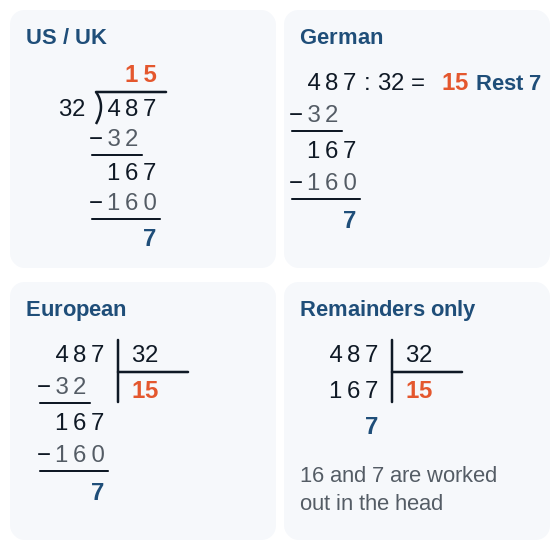
Same arithmetic, different paper — which matters when parent and child learned in different countries. The English-speaking world, India and East Asia use the bracket (the “bus stop” in British schools). Germany, Austria and Switzerland write 487 : 32 = 15 Rest 7 with the products underneath. Spain, Italy, France, Portugal, Brazil and most of Latin America put the divisor to the right behind a vertical line, quotient below it. Mexico, Argentina and Italian primary schools often write only the remainders. Pick yours under Layout: US / UK (bracket), German (487 : 32 =) or European (divisor on the right) — the calculator remembers it; switch off Write subtractions for remainders only.
Where the numbers come from
No floating-point approximations: both numbers are scaled to whole numbers by the same power of ten (4.71 and 3.2 → 471 and 320), then everything is exact integer arithmetic. The method is the school algorithm (Wikipedia, “Long division”); the never-negative remainder is Euclidean division.
- Decimal digits come from remainder × 10; each remainder is remembered, and when one returns, the digits since its first appearance are the period.
- Fixed places are worked one digit further and rounded half up: 22 ÷ 15 = 1.4666… → 1.467 to 3 places (cutting off gives 1.466).
- Fractions are reduced by the greatest common divisor; the sign is applied once, to the whole answer.
- Nothing leaves your device: Calculation history keeps your last 10 divisions in this browser (saved on Calculate, not while you type), and Share link puts the numbers in the address after a #.
| Division | Quotient and remainder | Decimal | Fraction or mixed number |
|---|---|---|---|
| 487 ÷ 32 | 15 R 7 | 15.21875 | 15 7/32 |
| 1 ÷ 7 | 0 R 1 | 0.(142857) | 1/7 |
| 612 ÷ 6 | 102 R 0 | 102 | 102 |
| 4.71 ÷ 3.2 | 1 R 1.51 | 1.471875 | 1 151/320 |
| −100 ÷ 7 | −(14 R 2) | −14.(285714) | −14 2/7 |
| 999999999999999 ÷ 7 | 142857142857142 R 5 | 142857142857142.(714285) | 142857142857142 5/7 |
For practice on paper, Make a practice sheet prints 10 or 20 problems in your layout (choose Divisor digits, Dividend digits, Remainders) with the Answer key on a separate page. If two-digit divisors are the trouble, read how to divide by a two-digit number.
Guides
 Long division with decimals: moving the point and repeating answersDecimal dividends, decimal divisors, adding zeros, the repeat bar and rounding vs cutting off — with 4.71 ÷ 3.2 worked out.6 min read
 How to divide by a two-digit number without endless guessingRound the divisor, estimate the digit, check with one multiplication — worked 487 ÷ 32, 1,904 ÷ 32, 2,584 ÷ 38 and 7,849 ÷ 23.6 min read
 Common long division mistakes and how to check your answerThe missing zero, a remainder that is too big, digits in the wrong column, decimal slips — and the check that catches them all.5 min read
Quick answers
Can this long division calculator show the work for each step?
Yes. It writes the full layout for your own numbers, with every quotient digit above its column and every multiply, subtract and bring-down row, zero digits included. The Step-by-step explanation says each move in a sentence, and Next step and Previous step go through it one move at a time.
What is the difference between the mixed number and the simplified fraction?
The Fraction card shows the whole answer as one simplified fraction, such as 25/2 for 100 ÷ 8. The Mixed number card splits off the whole part: 12 1/2. Both are reduced by the greatest common divisor, so 12 4/8 is shown as 12 1/2.
How large of a number can I divide?
Up to 30 digits in each field, positive or negative, with or without decimals. Everything is calculated exactly: 999999999999999 ÷ 7 gives 142857142857142 R 5, and decimals are never rounded before dividing.
Why does the result update before I press Calculate?
The calculator recalculates a moment after you stop typing, so you see the work change as you edit. Only a deliberate action — Calculate, Enter, the ± button, an example or a shared link — adds the division to your Calculation history, so half-typed numbers are never saved.
How do I check a long division answer?
Multiply the divisor by the quotient and add the remainder: you must get the dividend back, and the remainder must be smaller than the divisor. For 487 ÷ 32, 32 × 15 + 7 = 487. The Check line under the results does this for you.
What is the difference between long and short division?
It is the same method. In short division you multiply and subtract in your head and write only small carried remainders, which suits one-digit divisors. Long division writes every product and subtraction, which is easier to follow and check with two-digit and larger divisors.
Updated · About this site