Long division with decimals: moving the point and repeating answers
Updated October 13, 2026 · 6 min read · 6 sections

Decimals add exactly one rule to long division: the divisor has to be a whole number before you start. Everything else — divide, multiply, subtract, bring down — works as it does with whole numbers, and the point in the answer sits straight above the point in the dividend.
Below are the three situations worksheets throw at you, in the order schools usually teach them, and then the two things that trip people up at the very end: answers that repeat, and rounding.
A decimal in the dividend only
If only the number being divided has a point, do not move anything. Write the point in the quotient directly above the dividend’s point, then divide as usual.
7.5 ÷ 2. 2 goes into 7 three times: write 3, and 7 − 6 = 1. The point comes next in the dividend, so put a point after the 3. Bring down the 5: 15 ÷ 2 = 7, and 15 − 14 = 1. The digits have run out but the remainder is not zero, so write a 0 after the 5 and bring it down: 10 ÷ 2 = 5, remainder 0. The answer is 3.75.
9.6 ÷ 4 works the same way: 9 ÷ 4 = 2 with 1 left, point, bring down 6 → 16 ÷ 4 = 4. So 9.6 ÷ 4 = 2.4.
A decimal in the divisor: move both points
Nobody divides by 3.2 directly — “how many 3.2s fit in 4?” is not a question the bracket can handle. Instead, move the divisor’s point right until it is a whole number, and move the dividend’s point by the same number of places. You are multiplying both numbers by 10, 100 or 1000, and that never changes a quotient: 4.71 ÷ 3.2 is the same as 47.1 ÷ 32, just as 1 ÷ 2 is the same as 10 ÷ 20.
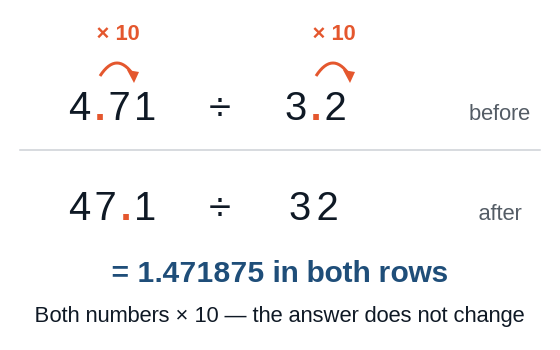
4.71 ÷ 3.2 → 47.1 ÷ 32:
- 32 goes into 47 once: write 1. 47 − 32 = 15.
- Put the point in the quotient above the point in 47.1. Bring down the 1: 151. 4 × 32 = 128, and 151 − 128 = 23. Write 4.
- No digits are left, so bring down zeros: 230 − 224 = 6 (digit 7); 60 − 32 = 28 (digit 1); 280 − 256 = 24 (digit 8); 240 − 224 = 16 (digit 7); 160 − 160 = 0 (digit 5).
- The remainder is 0, so stop: 4.71 ÷ 3.2 = 1.471875.
When the dividend has fewer decimal places than you need to move, fill in zeros: 6.3 ÷ 0.02 needs two places, so it becomes 630 ÷ 2 = 315. When the dividend has more places, its point simply stays inside it — 47.1 still has a decimal, and that is fine. Only the divisor must be whole.
| Problem | Move the point | Divide | Answer |
|---|---|---|---|
| 7.5 ÷ 2 | no move needed | 7.5 ÷ 2 | 3.75 |
| 9.6 ÷ 4 | no move needed | 9.6 ÷ 4 | 2.4 |
| 4.71 ÷ 3.2 | 1 place | 47.1 ÷ 32 | 1.471875 |
| 12.6 ÷ 0.3 | 1 place | 126 ÷ 3 | 42 |
| 45.9 ÷ 0.9 | 1 place | 459 ÷ 9 | 51 |
| 2.5 ÷ 0.4 | 1 place | 25 ÷ 4 | 6.25 |
| 0.5 ÷ 0.25 | 2 places | 50 ÷ 25 | 2 |
| 6.3 ÷ 0.02 | 2 places | 630 ÷ 2 | 315 |
Before trusting any answer, estimate. 4.71 ÷ 3.2 is a little less than 4.8 ÷ 3.2 = 1.5, so an answer near 1.5 makes sense, while 0.147 or 14.7 means a point moved the wrong number of places.
Adding zeros to keep dividing
Whole numbers can have decimal answers too. 487 ÷ 32 stops at 15 R 7 if you want a remainder, but if the task wants a decimal, write 487 as 487.00000 and carry on: 70 − 64 = 6, 60 − 32 = 28, 280 − 256 = 24, 240 − 224 = 16, 160 − 160 = 0. The digits 2, 1, 8, 7, 5 go after the point: 15.21875. The added zeros do not change the number — 487 and 487.000 are equal — they just give you something to bring down.
When the answer repeats: the bar
Sometimes the zeros never run out. 2 ÷ 3: 20 − 18 = 2, bring down a zero, 20 − 18 = 2 again. The remainder 2 came back, so the 6 repeats forever: 2 ÷ 3 = 0.666…, written as 0.6 with a bar over the 6. Many European countries put the period in brackets instead, 0.(6); British textbooks put a dot over the repeating digit.
The repeat does not always start right after the point. 1 ÷ 12: 10 ÷ 12 = 0 (remainder 10), 100 ÷ 12 = 8 (remainder 4), 40 ÷ 12 = 3 (remainder 4) — and 4 is back. So 1 ÷ 12 = 0.08333…, written 0.08(3), with the bar over the 3 only.
The rule that saves the most time: stop the moment a remainder repeats. Remainders are always smaller than the divisor, so the period can never be longer than the divisor minus one — at most 6 digits for 7 (1 ÷ 7 = 0.(142857)) and at most 96 for 97. And 1 ÷ 97 really does use all 96.
That is why the long division calculator watches remainders rather than digits. In Exact (repeat bar) mode it marks the remainder that came back, puts the bar over the period and tells you its length.
Rounding to n places is not cutting off
“Give the answer to 3 decimal places” means rounding. Work out one digit more than you need and look at it: 5 or more rounds the last kept digit up, 4 or less leaves it alone. 22 ÷ 15 = 1.4666…; the fourth digit is 6, so to 3 places the answer is 1.467. Simply stopping after three digits — truncating — gives 1.466, and some calculators that “calculate to n places” do exactly that. In the same way, 2 ÷ 3 to 4 places is 0.6667, not 0.6666.
In the calculator, choose 2, 4, 6, 10 or 20 under Decimal places. The result is rounded half up and labelled “≈ rounded to N places”, so you never mistake it for the exact value.
Remainders with decimal numbers
Most decimal work wants a decimal answer, but you can still ask for a whole-number quotient with a remainder. The remainder is then in the original units: 4.71 ÷ 3.2 = 1 R 1.51, because 3.2 × 1 + 1.51 = 4.71; and 7.5 ÷ 2 = 3 R 1.5. The calculator switches Answer as to Decimal as soon as a number has a point; switch it back to Remainder for this form. Commas work as decimal separators, so 4,71 and 3,2 give the same result.
If the decimals behave but two-digit divisors do not, the guide on dividing by two-digit numbers shows how to estimate each digit. And for the slips that cost the most marks, see common long division mistakes.
Quick answers
How do you divide a decimal by a whole number?
Divide as usual and put the point in the quotient straight above the point in the dividend. 7.5 ÷ 2 = 3.75; add zeros after the last digit while the remainder is not zero.
How do you divide by a decimal?
Move the divisor’s point right until it is a whole number and move the dividend’s point the same number of places, then divide. 4.71 ÷ 3.2 becomes 47.1 ÷ 32 = 1.471875, and 12.6 ÷ 0.3 becomes 126 ÷ 3 = 42.
When do I stop adding zeros?
When the remainder becomes 0, the decimal ends. When a remainder you have already seen comes back, the digits since then repeat forever. If the task asks for n places, work out n + 1 digits and round.
How do I write a repeating decimal?
Put a bar over the digits that repeat, or brackets around them: 1 ÷ 7 = 0.(142857) and 1 ÷ 12 = 0.08(3). Only the repeating part gets the bar.